
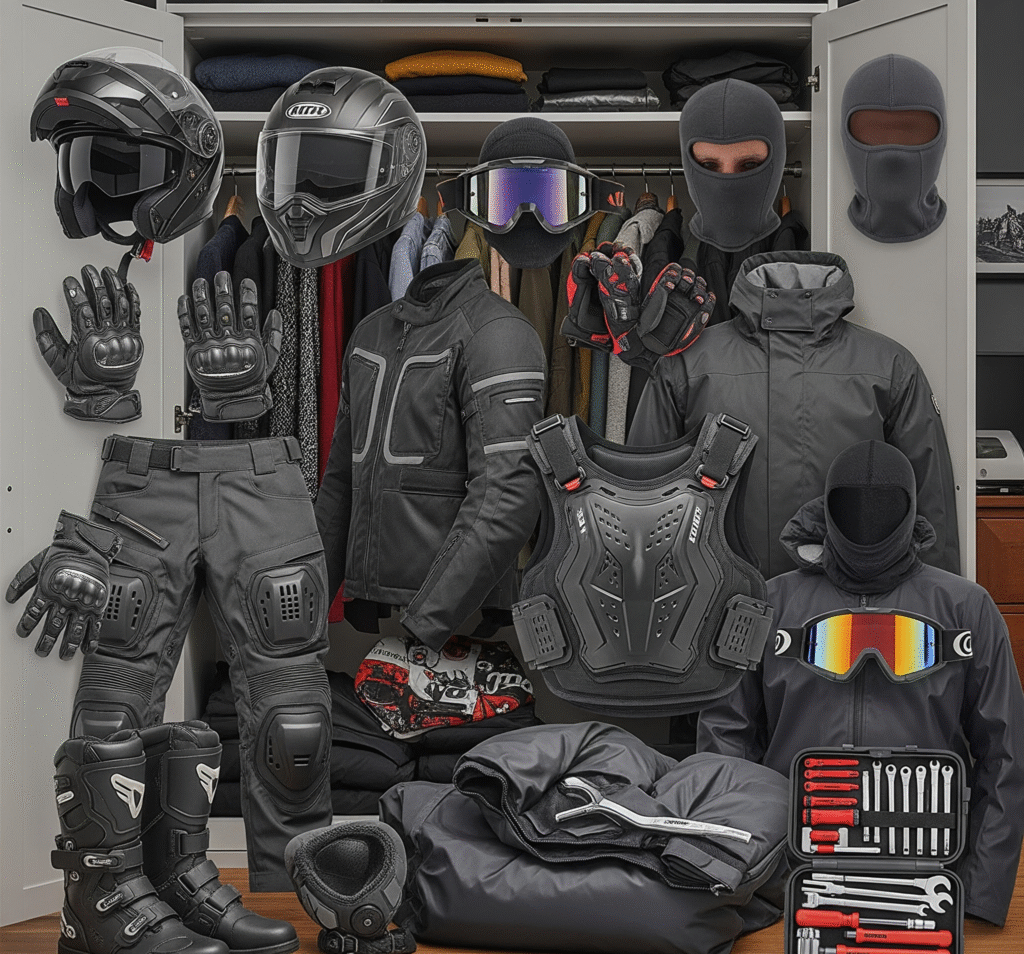
Motorcycle touring is a delicate dance between man, machine, and the environment. However, the true success of an expedition isn’t measured by the displacement of your engine, but by your level of technical preparedness. The right gear functions as your primary interface with the world—it is your climate control, your impact protection, and your endurance enhancer. Whether you are navigating the chaotic urban “jungle,” embarking on a multi-state odyssey, or tackling technical backcountry trails, the philosophy remains the same: Safety is the baseline, not an option. High-quality gear transforms a stressful struggle against the elements into a focused, comfortable, and life-changing journey.
The “All-Terrain” Preparedness Mindset
In 2026, we have moved beyond the “basic helmet” era. Modern riding gear is a sophisticated ecosystem designed to keep the rider’s “biological engine” running at peak performance. Preparation serves three critical pillars:
- Impact & Abrasion Protection: This is your “insurance policy.” In the event of a slide or a fall, your gear acts as a sacrificial layer, absorbing the kinetic energy that would otherwise be transferred to your skin and bones.
- Environmental Resilience: Windburn, dehydration, sunstroke, and hypothermia are silent enemies that drain your focus. Professional gear manages your body temperature, keeping you sharp and responsive.
- Fatigue Mitigation: Ergonomically designed gear reduces the physical “work” of riding. When your gear fits perfectly and blocks out distracting wind noise, you can ride longer, further, and safer.
The Complete Gear Manifest: From Crown to Sole
Below is the foundational checklist for every rider. Whether you are a weekend warrior or a cross-continental explorer, these items constitute your “Armor of Choice” before you ever kick up the side-stand.
| Gear Category | The Standard | Why It’s Essential |
| Head & Face | ECE 22.06 / DOT Full-Face Helmet | Protects your most vital asset. Full-face models offer critical jaw and chin protection. |
| Upper Body | Armored Textile or Leather Jacket | Features CE-rated protection for shoulders, elbows, and (crucially) the spine. |
| The Controls | Full-Gauntlet or Padded Gloves | Your hands are your primary tools. Palm sliders prevent wrist-shattering “grabs” during a fall. |
| Lower Body | Abrasion-Resistant Riding Pants | Reinforced with Kevlar or Cordura and knee/hip armor to protect the body’s largest joints. |
| The Foundation | Ankle-High Reinforced Boots | Prevents crushing injuries and provides the grip needed for slick or gravel-strewn stops. |
| The Vision | Pinlock-Equipped Visors / UV Shades | Ensures 100% visibility in rain, fog, or blinding high-altitude sun. |
Pro Tip: The “Always-Ready” Protocol
A common mistake is choosing gear based on the distance of the ride.
- The Reality: The road doesn’t know if you’re going 5km or 500km. Most accidents occur within a 15km radius of home or during low-speed maneuvers.
- The Fix: Adopt the “ATGATT” (All The Gear, All The Time) philosophy. Even for a short city “coffee run,” wear your helmet, gloves, and boots. Being prepared is a habit, not a chore—and it’s the only habit that ensures you’ll be around for the next long tour.
1. The Helmet: Your Primary Command Center
The helmet is the single most important piece of equipment you will ever own. It is not merely a legal requirement; it is a sophisticated “survival cell” for your brain. In 2026, helmet technology has evolved to handle not just direct impacts, but also “rotational forces” that can cause internal injury even without a skull fracture. Beyond safety, your helmet is your primary interface with the environment—it manages wind noise, regulates your temperature, and provides the optical clarity needed to spot hazards at high speeds.
Understanding the Safety Architecture
When selecting your “crown,” look for the gold standards of testing:
- Safety Certifications: In India, ISI is the legal baseline, but for touring, look for ECE 22.06 or DOT ratings. ECE 22.06 is the most rigorous modern standard, testing for impacts at multiple angles and speeds.
- The “Full-Face” Mandate: Statistics show that a significant percentage of helmet impacts occur on the chin and jaw area. Avoid open-face helmets at all costs; a full-face or high-quality modular helmet is the only way to ensure 360-degree protection for your face and head.
Features for the Long-Distance Rider
- Ventilation Systems: Look for “active” venting. Multiple intake ports at the chin and crown, with exhaust ports at the rear, create a “venturi effect” that pulls heat away from your head, preventing the fatigue caused by overheating.
- Optical Clarity: A Pinlock-ready visor is essential. A Pinlock is an insert that creates a double-pane effect, 100% preventing your visor from fogging up during cold morning rides or heavy rain.
- Weight & Aerodynamics: A lightweight helmet (ideally under 1500g) reduces the leverage on your neck muscles. Aerodynamic “spoilers” prevent the helmet from “lifting” or buffeting at highway speeds, significantly reducing neck strain.
- Bluetooth Integration: Most modern helmets are “Bluetooth-ready,” featuring recessed pockets for speakers. This allows for seamless intercom integration without the speakers pressing painfully against your ears.
The Marketplace
- Average Investment: ₹4,000 – ₹18,000+ (for mid-to-high-tier safety).
- Trusted Brands: MT, LS2, Axor, and SMK offer excellent ECE-certified options for touring. For premium safety and lightness, brands like Bell, Scorpion, or HJC are world-class.
Pro Tip: The “Impact Expiry”
A helmet is a “one-and-done” safety device. The internal EPS (expanded polystyrene) liner is designed to crush and absorb energy during a crash. Once it has done this, it cannot do it again.
- The Fix: If you drop your helmet on a hard surface from a significant height, or if you are involved in a crash, replace it immediately, even if there are no visible cracks. Even without an accident, the oils from your hair and UV rays degrade the materials over time—replace your helmet every 3–5 years to ensure the “glue” and foam are still at peak performance.
2. The Riding Jacket: Your Torso’s Exoskeleton
Your riding jacket is your primary shield against the unpredictable forces of the road and the elements. It serves a dual purpose: acting as a high-tensile “abrasion barrier” to protect your skin during a slide and a “structural cage” for impact-absorbing armor. In the context of touring, a jacket is no longer just about safety; it is an advanced climate-control system. Whether you are crossing the sweltering plains of Rajasthan or the freezing heights of Khardung La, the right jacket regulates your core temperature, preventing the thermal fatigue that dulls a rider’s reflexes.
The Anatomy of a Touring Jacket
A professional-grade jacket is built from high-denier fabrics (like Cordura) that can withstand extreme friction. Look for these critical components:
- CE-Rated Armor (The “Impact Zones”): Ensure the jacket comes with CE Level 1 or Level 2 protectors. Level 2 is thicker and absorbs more energy. At a minimum, you must have armor at the elbows and shoulders.
- The Spine Guard: Many entry-level jackets come with a simple foam pad in the back. Upgrade this to a CE Level 2 Back Protector immediately; your spine is the most critical structural component of your body.
- The Layering System: A true touring jacket is a “3-in-1” system. It should feature a mesh/textile outer shell for protection, a removable waterproof liner for rain, and a thermal liner for cold starts. This modularity allows you to adapt to changing weather in seconds.
- Ventilation Ports: Look for zippered air intakes on the chest and arms, with exhaust vents on the back. This “flow-through” ventilation is vital for preventing heatstroke during slow, technical off-road sections.
The Marketplace
- Average Investment: ₹6,000 – ₹25,000+ (Quality gear is an investment in your skin).
- Trusted Brands: India has world-class homegrown brands like Rynox, Viaterra, and Solace, which design specifically for our varied climates. Raida and Axor also offer excellent value-for-money entry points.
Pro Tip: The “Visibility Factor”
When you are touring, you are often sharing the road with heavy trucks and buses, especially during twilight or rainy conditions.
- The Fix: Always choose a jacket with 3M Scotchlite or high-visibility reflective piping. These elements should be placed on the back, shoulders, and chest. In the beam of a truck’s headlight, these reflective strips turn you into a glowing beacon, ensuring you are seen from hundreds of meters away. If your jacket is all black, consider wearing a lightweight fluorescent over-vest for the night-riding sections of your tour.
3. Riding Gloves: Precision Tools for Control and Protection
Your hands are your most vital instruments on a motorcycle; they manage the delicate inputs of throttle, braking, and steering that keep you upright. Because the human instinct during a fall is to put your hands out to break the impact, they are often the first part of the body to strike the pavement. Riding gloves are not just accessories—they are high-tech “input filters” that protect your skin from “road rash,” your bones from fractures, and your nerves from the constant, draining vibrations of the handlebars.
Key Protective Anatomy
A touring glove must balance extreme protection with the tactile “feel” required for safe operation:
- Knuckle Armor: Look for hard-shell protectors (often carbon fiber or TPU). These dissipate the energy of a direct impact and protect against flying debris or stones kicked up by vehicles ahead.
- Palm Sliders (Non-Negotiable): This is the most underrated safety feature. A palm slider is a hard plastic piece that allows your hand to slide across the road. Without it, your leather palm “grabs” the tarmac, causing your wrist to snap or your arm to tumble.
- Scaphoid Protection: Good gloves feature extra padding or sliders over the scaphoid bone (near the base of the thumb), which is one of the most frequently broken bones in motorcycle accidents.
- Tactile Conductivity: Most gloves come with touchscreen-compatible fingertips. This allows you to adjust your GPS or answer a call without the dangerous hassle of removing your gear on the roadside.
The Seasonal Strategy
| Glove Type | Best Use Case | Key Feature |
| Summer Mesh | Hot plains & city commutes | High airflow to prevent sweaty palms and “grip slip.” |
| Waterproof/Winter | Monsoon & High Altitudes | Features a “Hipora” or Gore-Tex membrane to keep hands dry and warm. |
| ADV/Dual-Sport | Off-road & Trails | Lightweight with extra grip on the fingers for better clutch/brake modulation. |
The Marketplace
- Average Investment: ₹1,500 – ₹8,000+
- Trusted Brands: Rynox, Viaterra, and Solace offer incredible technical gloves for the Indian climate. Axor and Raida provide excellent entry-level options that don’t compromise on basic safety.
Pro Tip: The “Goldilocks” Fit
A glove that is too tight will cut off blood circulation, leading to numb fingers and slow reaction times. A glove that is too loose will “bunch up” in your palm, causing painful blisters over long distances.
- The Fix: When trying on gloves, make a fist. There should be no painful pressure on your knuckles, and your fingertips should just barely touch the end of the glove. Ensure you can easily operate the turn signals and “pinch” small objects. A perfect fit ensures that the armor stays in the right place during an impact while keeping your hands fresh for an 8-hour riding day.
4. Riding Pants: The Foundation of Lower-Body Resilience
Your legs are the most exposed part of your body during a slide, yet they are often the most neglected. While many riders invest in a high-end helmet, they frequently rely on standard denim for their lower half—a dangerous mistake. Standard jeans can disintegrate in less than a second of contact with tarmac at highway speeds. Dedicated riding pants are engineered “safety systems” that combine high-tenacity abrasion resistance with impact armor, ensuring that a minor slide doesn’t result in life-altering skin grafts or joint injuries.
The Architecture of Leg Protection
Modern touring pants are designed to handle the “three stresses” of riding: impact, abrasion, and long-duration friction.
- Impact Armor (Knees & Hips): Most falls involve a direct impact on the knees or hips. Ensure your pants have CE-rated armor. Look for adjustable knee armor pockets; the protector must sit exactly over your kneecap when you are in a seated riding position, not just when you are standing.
- Abrasion Resistance: Professional pants use materials like Cordura 600D+ or Kevlar-lined denim. These fabrics are designed to “slide” without melting or tearing, protecting your skin from the intense heat and friction of the road surface.
- Ergonomic Stretch Panels: Riding requires constant movement—shifting gears, braking, and standing on pegs. Look for “accordion” stretch panels at the knees and lower back. These allow the pants to flex with you, preventing the “binding” that causes saddle fatigue.
- Thermal & Air Management: Touring pants often feature large thigh vents for hot days and removable waterproof/thermal liners for crossing cold mountain passes.
The Marketplace
- Average Investment: ₹5,000 – ₹15,000+
- Trusted Brands: Rynox and Viaterra are leaders in technical touring pants for the Indian sub-continent. Solace and Raida offer excellent “Kevlar-reinforced” riding jeans for those who want a casual look with professional-grade safety.
Pro Tip: The “Denim Delusion”
It is a common myth that “heavy-duty” regular jeans are enough for a tour.
- The Reality: Standard cotton denim has an “abrasion resistance” of roughly 0.6 seconds before it wears through to the skin at 60 km/h. Technical riding pants are rated to last 4 to 7 seconds or more.
- The Fix: If you find full textile pants too bulky for a short city ride, invest in Kevlar-lined riding jeans. They look like everyday wear but feature hidden protective liners and hip/knee armor. Never settle for “regular” clothes; the road is the same hardness regardless of the length of your journey.
5. Riding Boots: The Foundation of Stability and Safety
Your feet and ankles are composed of 26 delicate bones that are incredibly vulnerable in even a minor tip-over. While sneakers or hiking boots might feel comfortable, they are designed for walking, not for the high-velocity impacts or “crushing” forces of a motorcycle accident. Professional riding boots act as a structural brace, providing the rigid support needed to prevent ankle twists and the reinforced “shell” required to protect your toes and soles from being trapped under a falling bike. In 2026, a quality boot is the difference between walking away from a fall and a long-term orthopedic injury.
The Anatomy of Foot Protection
A dedicated touring boot is engineered with specific “fail-safes” that casual footwear lacks:
- Ankle Stabilization: Look for TPU or hard-shell inserts on both sides of the ankle bone (malleolus). These protect against impact and prevent the joint from “hyperextending” during a slide.
- Crush-Resistant Soles: Riding boots feature a stiffened shank in the sole. This prevents the foot from folding or being crushed if the weight of the motorcycle (often 200kg+) lands on it.
- Reinforced Toe Box & Heel Cup: A hardened front prevents your toes from being smashed by flying debris or during a front-end impact, while a rigid heel cup locks your foot in place.
- Anti-Slip Soles: When stopping on oily roads, loose gravel, or wet mountain inclines, your boots provide the “anchor.” Look for deep-tread, oil-resistant soles that ensure your foot doesn’t slide out when you put it down.
- Shifter Pad: A reinforced patch on the top of the left boot prevents the gear lever from wearing through the material and causing “shifter toe” pain during a long day of gear changes.
Choosing Your “Foot Armor”
| Boot Type | Best Use Case | Key Benefit |
| Full Touring Boots | Long-distance highways | Maximum shin and calf protection; usually waterproof. |
| Adventure (ADV) Boots | Off-road & Trails | Very stiff and rugged; designed for standing on pegs and surviving rock strikes. |
| Ankle/Short Boots | City & Short Tours | Offers basic ankle protection with more comfort for walking off the bike. |
The Marketplace
- Average Investment: ₹4,000 – ₹15,000+
- Trusted Brands: Raida, Orazo, and Tarmac offer excellent entry-to-mid-tier options suited for Indian roads. For premium protection and long-term durability, brands like Forma and Falco are industry benchmarks.3
Pro Tip: The “Sneaker Trap”
The most common mistake riders make is wearing high-top sneakers or “safety” work boots.
- The Reality: Most sneakers are held together by glue and light stitching; in a slide, they can be ripped off your feet in milliseconds, leaving your skin exposed. Furthermore, they offer zero lateral (side-to-side) protection for your ankles.
- The Fix: If you want a casual look, invest in Riding Sneakers—they look like high-tops but feature hidden ankle protectors, a stiffened sole, and reinforced toes. Never ride in standard footwear; if it isn’t designed to survive a slide on tarmac, it isn’t protecting you.
6. Body Armor / Riding Suit (Optional but recommended for long tours or off-road)
- Types: Chest protectors, knee braces, full riding suits (one-piece/two-piece).
- Use: High-speed or off-road touring.
- Average cost: ₹5,000 – ₹25,000
- Brands: Rynox, Solace, Axor, ProRider
- ✅ Pro Tip: Use removable armor so you can upgrade later.
7. Balaclava
- Why it’s essential: Keeps sweat away from your helmet padding; protects from cold, dust.
- Cost: ₹200 – ₹800
- ✅ Pro Tip: Carry two; they dry fast and are easy to swap mid-ride.
8. Goggles / Riding Glasses (if using off-road or open-face helmet)
- Purpose: Eye protection from dust, wind, and debris.
- Features: UV protection, anti-fog, tinted/clear options.
- Cost: ₹500 – ₹3,000
- ✅ Pro Tip: Always carry a clear lens for night riding.
9. Rain Gear / Waterproof Layers
- Why it’s essential: Sudden rain can ruin the ride if unprepared.
- Includes: Rain jacket & pants, waterproof gloves/boot covers.
- Average cost: ₹1,000 – ₹5,000
- ✅ Pro Tip: Choose high-visibility rain gear for low-light conditions.
10. Tool Kit & Emergency Accessories
- Recommended items:
- Multi-tool / pocket toolkit
- Tyre repair kit & portable air pump
- Zip ties, duct tape
- Chain lube, spare fuses
- Cost: ₹1,000 – ₹3,000 total
- ✅ Pro Tip: Always know how to use your tools before relying on them!
11. Additional Must-Haves
| Item | Why You Need It |
|---|---|
| Hydration bladder / bottle | Avoid dehydration on long stretches |
| Riding earplugs | Reduces wind noise fatigue |
| Mobile holder with charger | Navigation & communication on the go |
| First-aid kit | For minor injuries or scrapes |
| Reflective vest | Night visibility |

