
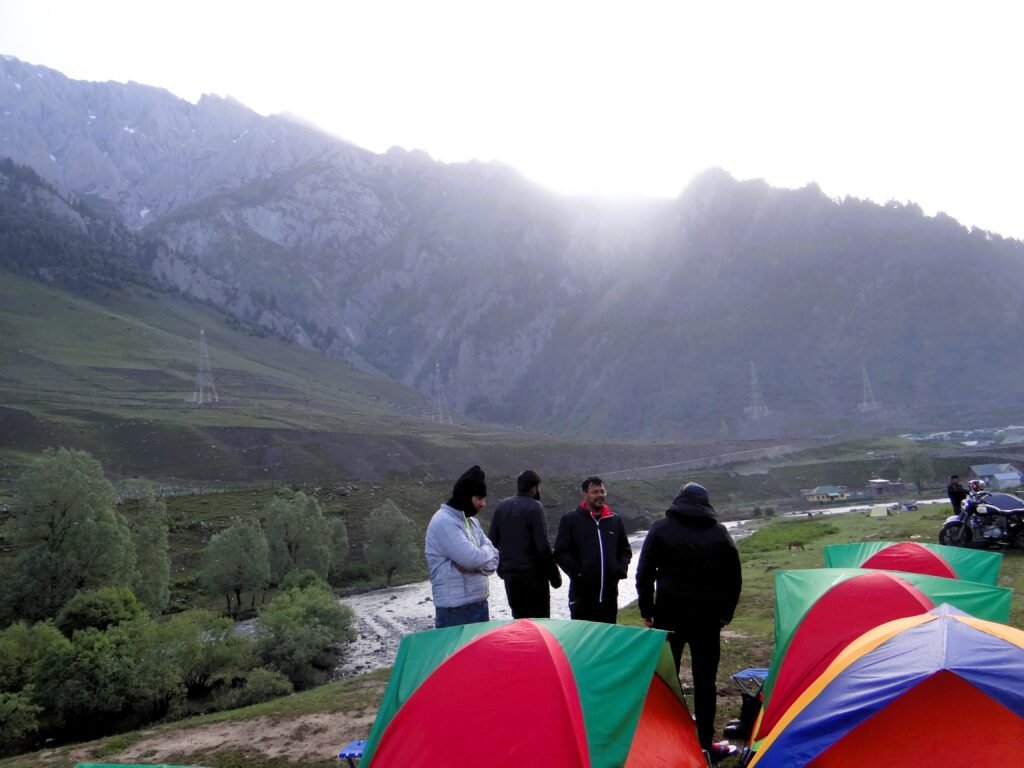
The Himalayas have a way of humbling the arrogant. We arrived in Sonamarg with the high spirits of city-dwellers chasing an Instagram-perfect adventure, unaware that the mountains were about to teach us a lesson in survival that we would never forget. This is the story of our first night under the stars—a night that was supposed to be a dream but turned into a freezing, wind-whipped nightmare.
1. THE COLD BREEZE: A Midnight Arrival in the Dark
The sun had long since dipped behind the jagged peaks of the Thajiwas range by the time our bikes rumbled into Sonamarg. In the mountains, darkness isn’t just the absence of light; it is a heavy, physical presence. Reaching a high-altitude destination at night is a tactical error we didn’t realize we were making.
We could hear the Sindh River before we could see it. It was a low, rhythmic growl—a constant reminder of the glacial melt moving just yards away from us. Because we arrived in pitch darkness, we couldn’t scout the terrain. Our only world was the narrow 20-foot beam of our bike’s LED headlights and the flickering glow of our handheld camping lanterns.
In our rush to set up, we found an open patch of ground. It felt firm enough, though our boots occasionally sank into mossy, wet patches. Exhausted and shivering, we made the fateful decision to pitch our tents on the edge of a small plateau, right at the river’s brim. We thought the “river view” in the morning would be worth it. We didn’t realize that the river was a natural wind tunnel, funneling ice-cold air directly into our campsite.
2. WRONG TENT DIRECTION: Inviting the Enemy Inside
In the world of professional mountaineering, “orientation” is everything. We, however, were not professionals. We were novices with brand-new gear and zero experience.
As we unpacked the tents, the wind began to pick up. It was a sharp, biting breeze that seemed to cut through our riding jackets. In our excitement to wake up to the sight of the rushing water, we made a “rookie” mistake: we pointed the tent doors directly toward the river.
In any tent, the door is the structural Achilles’ heel. It is the point where zippers create tiny gaps and where the fabric is most vulnerable to pressure. By facing the doors toward the wind-tunnel of the river, we essentially turned our tents into wind-socks. Every gust of Himalayan air was scooped up by the door flaps and injected directly into our living space. We had literally invited the cold to sleep with us.
3. THE VENDOR’S LIES: Over-Promised and Under-Prepared
Before leaving Delhi, we felt confident. We had spent hours watching YouTube “influencers” and had visited a local vendor who promised us the world. He pointed at the labels: “Rated for -7°C,” he claimed. “You’ll be sweating inside these,” he promised.
Trusting a vendor without a reputation is a mistake that can cost you your life in the mountains. At Sonamarg, the temperature hovered around 5°C—well within the supposed “limit” of our gear. But as soon as we crawled inside, the reality set in.
The fabric of the tents felt like cheap umbrella material. It was thin, translucent, and lacked any thermal coating. Within minutes, the interior of the tent was the same temperature as the exterior. There was no “micro-climate” being created; the gear was a failure. We were victims of “marketing over-matter,” depending on the word of a salesman who had likely never spent a night above 10,000 feet.
4. THE DESIGN FLAWS: Corners of Ice
A small camping tent is a game of geometry. Usually, you place your luggage on one side to act as a windbreak and sleep on the other. But because our tents were so narrow and the material so poor, the “corner” of the tent became a block of ice.
The air seeped through the stitching of the floor and the walls. Every time I shifted, my shoulder would touch the side of the tent, and it felt like touching a frozen steak. There was no escaping the draft. The “lightweight” nature of the tent, which we thought was a benefit during the ride, was now our greatest enemy. It lacked the density to stop the wind, vibrating violently with every gust, making a noise like a snapping whip all night long.
5. THE SLEEPING BAG STRUGGLE: A Nylon Coffin
If the tent was the first line of defense, the sleeping bag was our last. But as I unrolled mine, my heart sank. It was a single layer of thin nylon, barely thicker than a summer windbreaker. There was no loft, no down filling, and no thermal trap.
I climbed in, still wearing my heavy winter jacket. But while my torso was somewhat warm, my legs felt like they were being dipped in ice water. In a desperate move, I took off my spare puffer jacket and wrapped it around my feet inside the bag. I wore three layers of socks, thermal liners, and heavy cargo pants, but the cold still found a way.
The bag was so narrow that I couldn’t even bend my knees to trap body heat. I felt like I was in a nylon coffin—tight, cold, and suffocatingly uncomfortable. Every time I breathed, the moisture from my breath condensed on the inner wall of the tent, eventually dripping back down on my face as freezing “indoor rain.”
6. THE UNFORGETTABLE SLEEP: Horses and Night Terrors
Sleep never came. At best, we achieved a state of “shivering exhaustion.”
Adding to the misery were the sounds. Because we were in an open grazing ground, the local Himalayan horses were roaming free. In the pitch black, you could hear their heavy hooves thumping on the wet earth just inches from our heads. Every snort and neigh sounded like a wild beast prowling the camp. The psychological fear of being trampled, combined with the physical torture of the cold, made for a long, grueling night. We lay there, paralyzed by the temperature, counting the minutes until dawn.
7. THE PLEASANT COLD MORNING: The Sun as a Savior
Around 5:30 AM, the sky began to turn a bruised purple. We crawled out of our tents, our joints stiff and our faces pale.
The sight that greeted us was bittersweet. The valley was stunning. The peaks were catching the first golden rays of the sun, and the river we had feared all night was sparkling like diamonds. But the beauty couldn’t hide the truth: we were in trouble. If we couldn’t survive a 5°C night in Sonamarg, how were we going to survive a -10°C night in Sarchu or Leh? We realized that continuing with this gear was a suicide mission.
8. CRITICAL LESSONS: A Guide to Buying Camping Gear
Our failure is your education. If you are planning a ride to Ladakh, do not buy your gear blindly. Here is the framework we learned the hard way:
I. Understand Temperature Ratings
Most people look at the “Extreme” rating on a sleeping bag and think they are safe. This is a mistake. There are usually three ratings:
- Comfort: The temperature at which a person can sleep soundly without feeling cold.
- Limit: The temperature where you will survive but feel cold.
- Extreme: The “Survival” rating. You won’t die, but you won’t sleep, and you risk frostbite. Always buy gear where your expected nighttime temperature matches the “Comfort” rating.
II. The Reputed Vendor vs. The Local Shop
In the mountains, brand names like Decathlon (Forclaz/Quechua), North Face, or Columbia aren’t just about status; they are about R&D. These companies test their gear in labs. Local vendors often “guess” the ratings or print whatever the customer wants to see. If you buy from a reputed store, you get a warranty and, more importantly, a product that has been field-tested by actual mountaineers.
III. The Layering Secret
The temperature rating of a tent assumes you are using a high-quality R-rated sleeping pad. We slept on the cold ground with just a thin tent floor between us and the wet earth. The ground will suck the heat out of your body 25 times faster than the air. Always invest in an insulated sleeping mat.
IV. The Power of Reviews
Before buying, search for “Real-world reviews” on YouTube, not just “Unboxing videos.” Look for people who have actually used the gear in Ladakh or Spiti. Look for long-term feedback regarding zipper durability and water resistance.
V. Price vs. Value
Cheap gear is expensive if you have to replace it halfway through your trip—or if it results in a medical emergency. Expect to pay a premium for “Down” (feather) filling over “Synthetic” filling, as Down provides a much better heat-to-weight ratio.
THE PATH FORWARD
That morning in Sonamarg, as we packed our damp, useless tents, we had a choice: give up and go home, or adapt. We chose to adapt. We decided that from that night on, we would prioritize safety over “the camping experience” until we could secure better equipment.
The Himalayas are beautiful, but they are indifferent to your survival. They don’t care about your YouTube videos or your “ready-to-eat” breakfast. They only respect preparation.
Stay tuned for the next chapter of our journey, where we face the legendary Zoji La and realize that the cold was only the beginning of our challenges.
Subscribe my youtube channel for stories of such adventurous trips – Subscribe
For latest travel plans and updates, follow me on Instagram – Follow
Follow this journey from the beginning – Ultimate journey to the land of sensation passes

