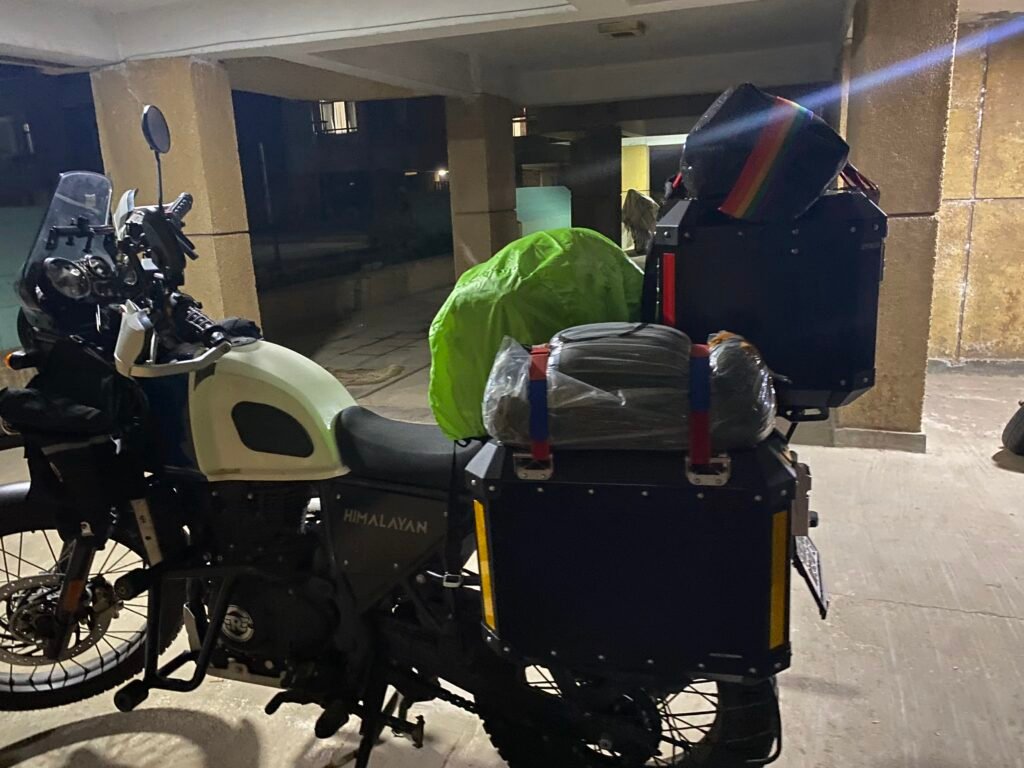
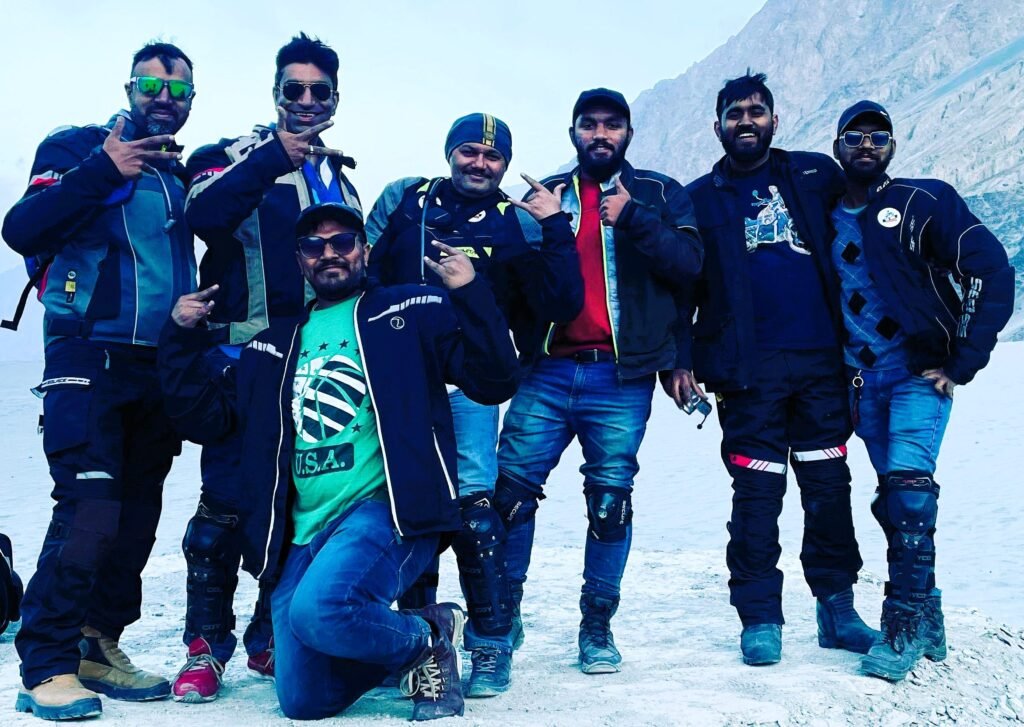
This story belongs to seven friends who first crossed paths within a motorcycle riding group in Delhi. Initially, we were complete strangers, linked only by a single, burning commonality: a raw passion for the open road and the hum of an engine. At that time, we were blissfully unaware that our shared hobby would eventually lead us to some of the most sensational and remote corners of the world.
We planted the seeds of our Ladakh saga in early 2021 during a somber period when the pandemic’s second wave peaked and travel felt like a distant memory. This forced isolation only fueled our desire for the open road; while the world stayed locked behind doors, we spent our evenings on Zoom calls, obsessively tracing maps and debating gear choices. We used that downtime to transform our restlessness into a concrete plan, knowing that once the borders reopened, we would be the first to head toward the mountains.
How We Planned Our Sensational Ladakh Expedition
What began as a desperate escape from a grim reality eventually blossomed into the most ambitious journey of our lives, proving that even in the darkest times, the call of the Himalayas remains impossible to ignore. By September 2021, as the world began to breathe again, our group seized the opportunity to plan something monumental. However, we knew Ladakh was no joke; it is a high-altitude desert that demands respect and meticulous preparation. None of us had ever ventured this far or remained on the saddle for such a grueling duration. We calculated that we needed at least 12 days to conquer the ambitious itinerary we had set for ourselves.
Our excitement reached a fever pitch as the planning phase went into overdrive. We dubbed ourselves “The Lucky Seven,” and the gravity of the challenge began to set in as we prepared our machines for the “Land of High Passes.” Our journey was to commence in New Delhi, the gateway to the north. From here, riders face a critical choice between two legendary routes to reach Leh: the lush, winding climb through Srinagar or the rugged, high-altitude ascent via Manali. Both paths offer their own set of perils and breathtaking rewards, and choosing between them was the first step in an adventure that would change us forever.
ROUTE 1: Delhi – Ambala – Manali – Leh
Delhi to Manali and then to Leh is the shortest route, however, it has some challenges which every traveller must consider prior to selecting this route, specially family travellers those travelling with kids or any heart disease patient.
Cons:-
- Altitude – The distance from Manali to Leh is approximately 430Kms and is covered with high passes including BaralachaLa, NakeeLa, Lachung-La and TaglangLa. Manali is located at a height of 2,050 m (6,730 ft) and BaralachLa is located at a height of 4,850 m o (15,910 ft). Distance from Manali to Baralachala is approximately 145Kms, which can be easily covered within 4 hours and that is a greater cause of concern as the traveller will be moving from 2020m to almost 5000 m within a very short timespan. This can cause alltitude sickness in many travellers like young children, older generation and specially those suffering from a heart disease.
- Lack of fuel stations – After Manali last fuel station is in Tandi and distance from Tandi to Leh is approximately 366Kms, therefore vehicles beyond that much fuel capacity must carry extra fuel. There are places where one can get fuel in black but, that is not recommended as it does not gurantee the fuel quality and could damage your vehicle.
- Quality of road – As stated earlier, this route has many passes and most of those receive quite a few snow fall in case you are travelling in May and early June. Due to this, certain times road gets wet or slippery. Also, at some patches roads are really narrow.
- Traffic – The route is used by trucks and other heavy vehicles and due to quite a few narrow patches specially on the high passes, traffic would be slower or there will be long traffic jams which could make your journey longer and tiring. In recent years, due to heavy rush and landslides there were several news of hours long traffic jams and even some stuck for days.
Pros:-
- Scenic Beauty – Inspite of several challenges Manali to Leh, Ladakh route has some breath taking views, I personally feel that this side of Himachal – Ladakh route is more scenic, therefore, whether going towards or coming back from Ladakh one must include this route in their itenary.
- Distance – Manali to Leh, Ladakh route is shorter than the one going through Srinagar-Zozila which is approximately 1200Kms where as this route is much shorter approximately 930Kms, a difference of 270Kms.
- Lesser Fuel – With increasing fuel prices and 270 Kms less to travel, which eventually saves both time as well as cost, this route would be anybody’s first choice.
Google Maps Link: Delhi – Manali – Leh
ROUTE 2: Delhi – Ambala – Srinagar – Zozila – Kargil – Leh
Delhi – Ambala – Manali -Leh (Ladakh), this route might be shorter, scenic, fuel efficient but, yet few travellers would agree that Leh via Srinagar, Sonamarg, Zozila, Kargil is a better route specially for those who like to gather memories of the magnificent Kashmir, mesmerizing beauty of Sonamarg (Sonmarg), Patriotic vibe of Drass and Kargil.
Cons:–
- Traffic – Route from west passes through many cities like Srinagar, Kargil and so on, the route at times get to much traffic specially at Banihal, however, authorities are building several tunnels and also road extension work is on the go.
- Distance – Certainly, this route has better waypoints however, it is approximately 270 Kms extra which one require to travel uptil Leh, Ladakh. This require extra fuel as well as extra time at least 1 additional day.
Pros:-
- Waypoints – This route covers many of the fantastic waypoints like Natha top (Patni top)-Jammu, Srinagar, Sonamarg(Sonmarg), Zozila pass, Drass, Kargil war memorial (Kargil), and many more. One would agree that this route is more interesting specially if you have time and more money on the fuel to spent.
- Fewer high mountain passes – The road till Zozila pass 3528 m (11575 ft) has been fully built up and other than monsoon season and peak winter season Zozila would be a operational and open for tourists.
- Better road quality – The route has better roads and would be even better in coming years when the work for Zozila tunnel would be over and available for use. Authorities are also building new tunnels on Srinagar highway other that the few already available.
- Access to fuel – There is abslutely no issue in availability of fuel on this route. There are fuel station at regular distances. Except for the Zozila pass there are fuel station prior as well as after crossing Zozila.
Google Maps Link: Delhi – Udhampur – Srinagar – Leh
Route Selection
While most of us were experienced on the road, we were all novices when it came to the unique demands of the Himalayas; none of us had ever tackled the daunting terrain of Ladakh on two wheels. I had visited the region back in 2012, but that was a cushioned, packaged tour where a driver handled the logistics. During that trip, however, I encountered a solo rider who had traveled thousands of kilometers from Bangalore. His grit stayed with me.
Even more inspiring was the sight of a family at the summit of the mighty Khardung La—including a young child—perched on a motorcycle. That was the spark. Standing there in the thin air, I vowed that I would one day return not as a passenger, but as a rider. Now, the time has finally come to fulfill that decade-old promise and face the “Land of High Passes” on my own terms.
After weighing the seasonal risks, we chose the Srinagar-Zojila route for our ascent. In late May, the Manali-Leh highway is notoriously unpredictable, often buried under late-season snow that can trap riders for days. We prioritized a steady, gradual acclimatization over the raw, high-altitude brutality of the Manali climb. For anyone following in our tracks from Delhi, Ambala is your moment of truth. This critical junction forces a decision: head north toward Pathankot and Udhampur for the Srinagar approach, or veer toward Bilaspur and Mandi for the legendary Manali highway. It is a choice that dictates the entire rhythm, temperature, and difficulty of your expedition.
Final Plan (DAYWISE)
- 1 – Delhi to Udhampur via Pathankot (623 Kms)
- 2 – Udhampur to Srinagar (182 Kms)
- 3 – Srinagar to Sonamarg (80 Kms)
- 4 – Sonamarg to Leh (332 Kms)
- 5 – Leh (Local travel)
- 6 – Leh to Nubra valley via KhardungLa (160 Kms)
- 7 – Nubra valley (Local travel) – Turtuk – Thang
- 8 – Hunder to Pangong TSO (Pangong Lake) (240 Kms)
- 9 – Pangong
- 10 – Pangong to Hanle (160 Kms)
- 11 – Hanle to UmlingLa to Hanle (No official route)
- 12 – Hanle to Karu (220 Kms)
- 13 – Karu to Jispa (301 Kms)
- 14 – Jispa to Manali (94 Kms)
- 15 – Manali to Delhi (500 Kms)
It was approximately 3500 Kms what we travelled on the Ladakh trip, Delhi – Srinagar – Ladakh – Manali – Delhi, which riders call as Ladakh circuit.
You can plan a Ladakh trip for 10 to 12 days, though travelers flying in often compress their schedule. Even when you fly, experts recommend spending at least 8 to 9 days to truly experience the region’s essence. To us, Ladakh represents more than just another destination; it feels like an entirely different planet that a single journey cannot fully uncover.
The vastness of the landscape and the complexity of the terrain demand multiple visits to truly appreciate its beauty. We quickly realized that rushing through such a majestic environment would be a disservice to the adventure. One must take the time to breathe in the thin mountain air, connect with the local culture, and let the silence of the high-altitude desert settle in. Every valley hides a new secret, and every mountain pass offers a different perspective, proving that you simply cannot explore this alien world in one go. Even if you cover most of the places, it will stay in your mind and force you to return.
LADAKH – NEVER ENDING ULTIMATE PREPARATION FOR THE ADVENTURE