May 14, 12:00AM it is. A journey to Ladakh, which we all were waiting since long. For all of us it is a dream come true. A fantasy, a fairy tale which was too good to be true.
If you are new to this blog, please checkout my previous blogs related to Ladakh journey that would add more fun to this story. Blog 1 – LADAKH – ULTIMATE JOURNEY TO THE LAND OF SENSATIONAL PASSES
Deja Vu Day
To me, this departure feels like a profound moment of déjà vu—a strange mixture of soaring excitement and cold, creeping fear. I stand at the threshold of a journey that promises to be as long as it is adventurous, yet the undeniable reality weighs heavily on my heart: I am leaving my family behind for the longest period in my life. Being away from home for fifteen days might seem standard to some, but when you are navigating the high-stakes environment of a cross-country ride, that distance feels magnified a thousand times over.
Bike riding is inherently dangerous, particularly on Indian roads where the infrastructure shifts from smooth highways to treacherous, non-existent mountain tracks without warning. You face a chaotic ecosystem of drivers where skill is rare and recklessness is the majority. I’ve realized that no matter how strictly you follow traffic rules or how defensively you ride, the road remains an unpredictable beast. You can control your own machine, but you can never control the “crazy” factor of the traffic around you.
On a motorcycle, the risk profile increases tremendously. Covering 3,500 kilometers over two weeks means you are constantly exposed to the elements, physical exhaustion, and mechanical vulnerability. There is always a nagging sense that something—an oil slick, a loose boulder, or a distracted driver—is waiting to happen. Fatigue begins to cloud your judgment, and your nerves fray under the constant vigilance required to stay upright. This journey, in particular, holds several stories where the line between a successful adventure and a tragic end became terrifyingly thin. As I gripped my handlebars on that first morning, I knew that this trip would not just test my riding skills, but my mental resolve to make it back home in one piece.
WARNING: Overloading is a mistake
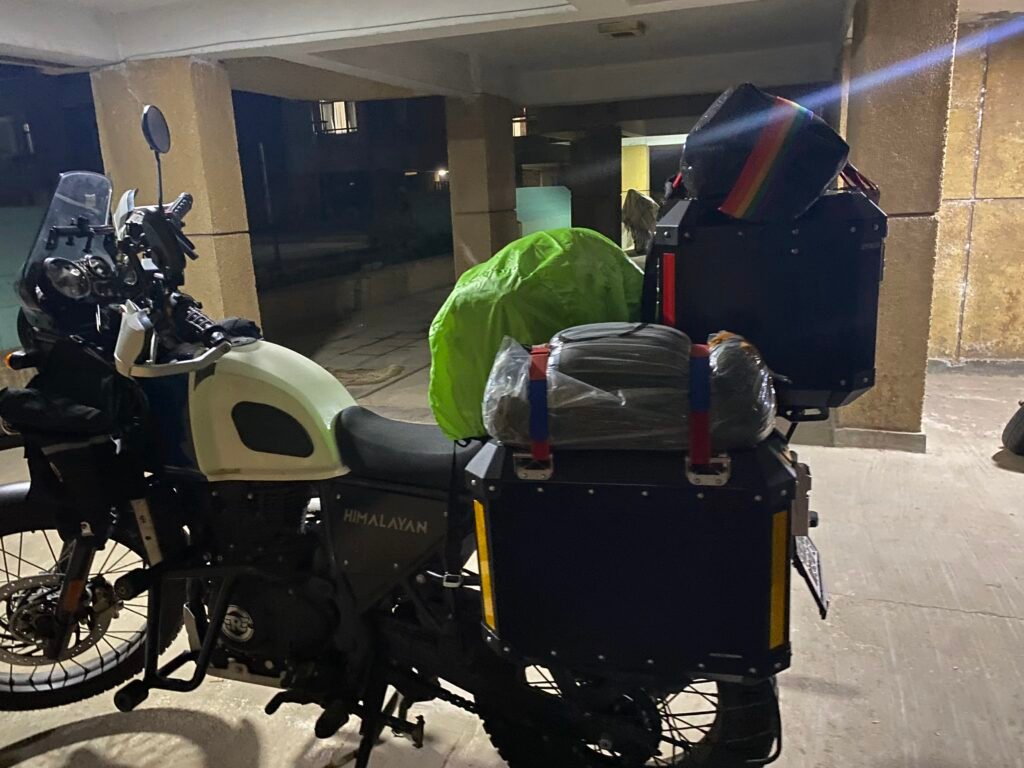
Every newcomer to the world of long-distance touring inevitably falls into the same trap: overloading their motorcycle with gear they will never actually use. We were no exception to this rule. If you look at the photo of my bike, you’ll see it already looks like a pack mule, and that was before I even mounted the tank bag. My lack of experience, coupled with a nagging fear of being unprepared for the remote Himalayas, drove me to pack far too much.
As a Royal Enfield Himalayan rider, I started with a machine that already weighed 200kg dry. By the time I strapped on 50kg of luggage, I was wrestling with a 250kg beast. Once you account for my own weight and the heavy protective riding gear, I was essentially piloting a 330kg machine down some of the world’s most treacherous roads. This created a dangerous physical imbalance—a 70kg rider attempting to manhandle a bike nearly five times his own weight.
This excessive weight didn’t just affect the bike’s fuel efficiency; it fundamentally changed its handling and safety. In the thin air of high-altitude passes, every extra kilo makes the bike more sluggish and harder to brake. Had I stalled or tipped over on a steep incline or a narrow mountain ledge, there was absolutely no way I could have recovered the bike alone. I had transformed a nimble adventure tourer into an overstuffed, top-heavy liability, a mistake that made every technical section of the road twice as exhausting as it needed to be.
Identifying the mistake
Before diving into the ride itself, I know many of you are staring at the photos of my overloaded bike and wondering: What on earth was he thinking? The answer lies in the single biggest mistake we made, a blunder born of romanticized ambition that most first-time long-distance tourers commit: the decision to carry a full camping setup.
Take it from me—never plan to camp on a grueling, multi-day journey unless you intend to sleep under the stars for at least 60% to 70% of your trip. We lugged around a heavy tent, sleeping bags, insulated mattresses, cooking gas canisters, a portable stove, utensils, and a massive supply of ready-to-eat food. This equipment alone consumed nearly 60% of our precious luggage space, with my top box stuffed entirely with food packets.
By carrying this “survival kit,” we effectively turned our nimble motorcycles into sluggish freight trains. We sacrificed maneuverability and physical energy for a “just in case” scenario that rarely materialized. In the harsh terrain of the Himalayas, every extra kilogram feels like ten, and the exhaustion of setting up a camp after a ten-hour ride is often the last thing you want to do. Stay tuned for the upcoming chapters of this journey; you will soon see exactly why carrying a mobile home is a recipe for burnout and why I now strongly recommend against camping for such high-intensity expeditions.
The journey begins
“Mukarba chowk” also known as the karnal bypass was our meeting point for this ride. If you are travelling from Delhi then this is the place where usually every journey to the north of India starts.
All 7 of us were ready to roll but, the cherry on the cake was our fellow riders who acompany us at the meeting point. They came to meet us and bless us with their love and luck for the journey (below picture) – sorry for the poor quality image, we could manage only this at that moment.
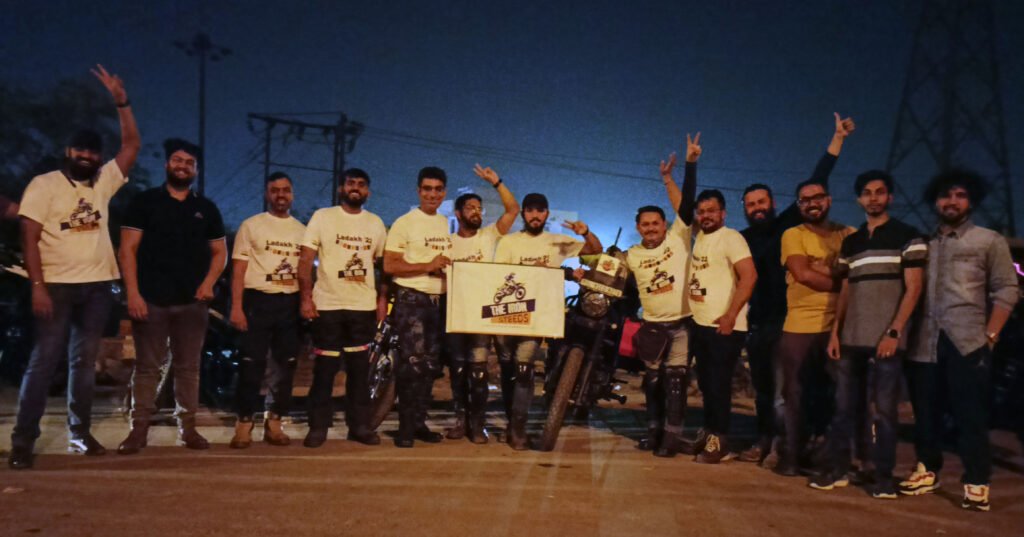
For the better understanding, lets name all the riders from left to right (only those going to Ladakh). Starting from 3rd on the left of the picture is myself- Akshay, then Akshansh, Karan, Dipesh, Mehar, Surender and Sandy. We are the 7 warriors from our group “The Iron Steeds“, who started this journey and all of us going Ladakh on a bike for the first time.
First Checkpoint
Our journey kicked off under the cover of darkness at 4:30 AM, yet we hit our first unplanned pause almost immediately at Pehalwan Dhaba in Murthal. While we hadn’t scheduled a stop so early, several fellow riders joined our convoy to see us off, making a farewell meal at this famous roadside landmark inevitable. Murthal is a legendary pitstop for travelers, renowned for its butter-soaked Paranthas, but our decision to indulge in light snacks there cost us precious time. By the time we finished, we had covered a measly 70 kilometers of the daunting 650-kilometer stretch required to reach our Day 1 destination: Udhampur.
This early delay effectively sabotaged our primary strategy. We had originally aimed for a 3:00 AM departure to outrun the punishing May heat and the suffocating morning traffic of the plains, but by 5:30 AM, the sun was already beginning to peak over the horizon. The cool morning air we had hoped to capitalize on quickly vanished, replaced by the rising glare of a summer sun that promised a grueling day ahead. We realized with sinking hearts that our goal of reaching the cooler altitudes of Jammu before the midday peak was now physically impossible.
BLISTERING HEAT AND LACK OF SLEEP
The standard route from Delhi to Srinagar typically mandates an overnight halt in Udhampur to bisect the massive distance, but the relentless, searing heat made every single kilometer feel like five. We spent the remainder of the day in a constant battle against rising engine temperatures and our own mounting exhaustion as the “Delhi heat” pursued us like a predator deep into the Punjab plains. This first day quickly transformed from a simple transit leg into a high-stakes test of human endurance, setting a chaotic, survivalist tone for the remainder of the trip.
However, I cannot encapsulate the sheer intensity of this experience in a single post; this is a sprawling saga, a dream for some of you, but a waking nightmare for those on the saddle. Operating a heavy motorcycle while encased in thick, protective riding gear during a blistering 45-degree heatwave is a feat that borders on the impossible. The heat doesn’t just make you sweat; it bakes you inside your armor, draining your cognitive functions until every decision feels heavy.
A GAMBLE NOBODY SHOULD PLAY
Compounding the heat was a dangerous lack of sleep. Having pushed ourselves from 5:00 AM until 5:00 PM without yet reaching our destination, we were operating on fumes. We consumed gallons of water, pouring it both into our parched throats and over our heads just to keep our core temperatures from spiking, yet the dehydration still clawed at us. Perhaps most terrifyingly, the “highway hypnosis” set in, causing us to drift in and out of consciousness while still moving at high speeds.
Looking back, this wasn’t just a ride; it was a reckless gamble with our lives—a gamble I hope no one reading this ever takes. Pushing through such extreme thermal stress without adequate rest is a recipe for tragedy. We weren’t just skilled; we were incredibly lucky to survive that first day and earn another chance to see the mountains.
Subscribe my youtube channel for stories of such adventurous trips – Subscribe
For latest travel plans and updates, follow me on Instagram – Follow
Related Posts
ZANSKAR-THE HIDDEN INDIA-KARGIL TO PADUM
Welcome to the second blog of the Zanskar series, in…
LADAKH-TICKING TIME BOMB-A Mechanical Nightmare on the Road to SONAMARG
The Himalayas demand more than just physical endurance; they serve…